
Start elsewhere if you are new: Show Me (outcomes and artifacts), Introduction (why install), How It Works (install map). This page is the internal architecture name and C4 decomposition — read it after you understand the delivery chain on the home splash and Show Me.
What this is
Section titled “What this is”AI Native SDLC is operational infrastructure for long-horizon agent-driven engineering. We document it internally as a Procedural Cognitive Runtime Architecture — the harness coordinates cognitive work; the LLM supplies inference inside it.
The central object is not the LLM. It is not the agent persona. It is the runtime harness: the layer that coordinates, governs, provisions, validates, and evolves procedural cognitive execution across sessions, agents, and environments.
LLMs provide inference. The harness provides continuity, governance, and operational integrity.
The organizing problem
Section titled “The organizing problem”Modern agent runtimes can reason, plan, call tools, and produce code. In isolation, that loop handles short tasks well.
It fails at long-horizon engineering because:
- context is a finite resource — context explosion is structural, not incidental
- sessions start cold — no durable operational state survives session boundaries
- “done” is a language claim — not a verified stage transition
- expertise lives in prompts — not in reusable, versionable procedural infrastructure
- observability stops at tool calls — the SDLC process itself is invisible
The architecture exists to solve long-horizon procedural cognitive execution — sustaining multi-session, multi-agent, end-to-end engineering workflows without contextual collapse.
Runtime harness vs agent
Section titled “Runtime harness vs agent”A common confusion: treating the agent as the architecture.
| Layer | Role |
|---|---|
| LLM | Inference — reasoning, decomposition, adaptive decisions |
| Agent persona | Specialized cognitive role — planner, implementer, reviewer, QA |
| Runtime harness | Operational infrastructure — lifecycle, hooks, memory, gates, orchestration |
| Procedural DSL | Executable specification — what the harness must sustain |
| Materialization | Deterministic enforcement — doctor, gates, init, integration provisioning |
The agent coordinates. It does not hold operational expertise.
Expertise is externalized procedurally through:
- skills — SDLC orchestration compositions
- playbooks — atomic domain procedural specifications
- commands — orchestration entry points
- workflows — stage contracts bound to the DSL
- memories — structured operational cognition state
- handoffs — session continuity artifacts
The agent’s job: reason, decompose, select, coordinate, provision capabilities, validate flows, manage execution. The harness’s job: make that coordination reproducible across time.
Two abstraction layers in the ecosystem
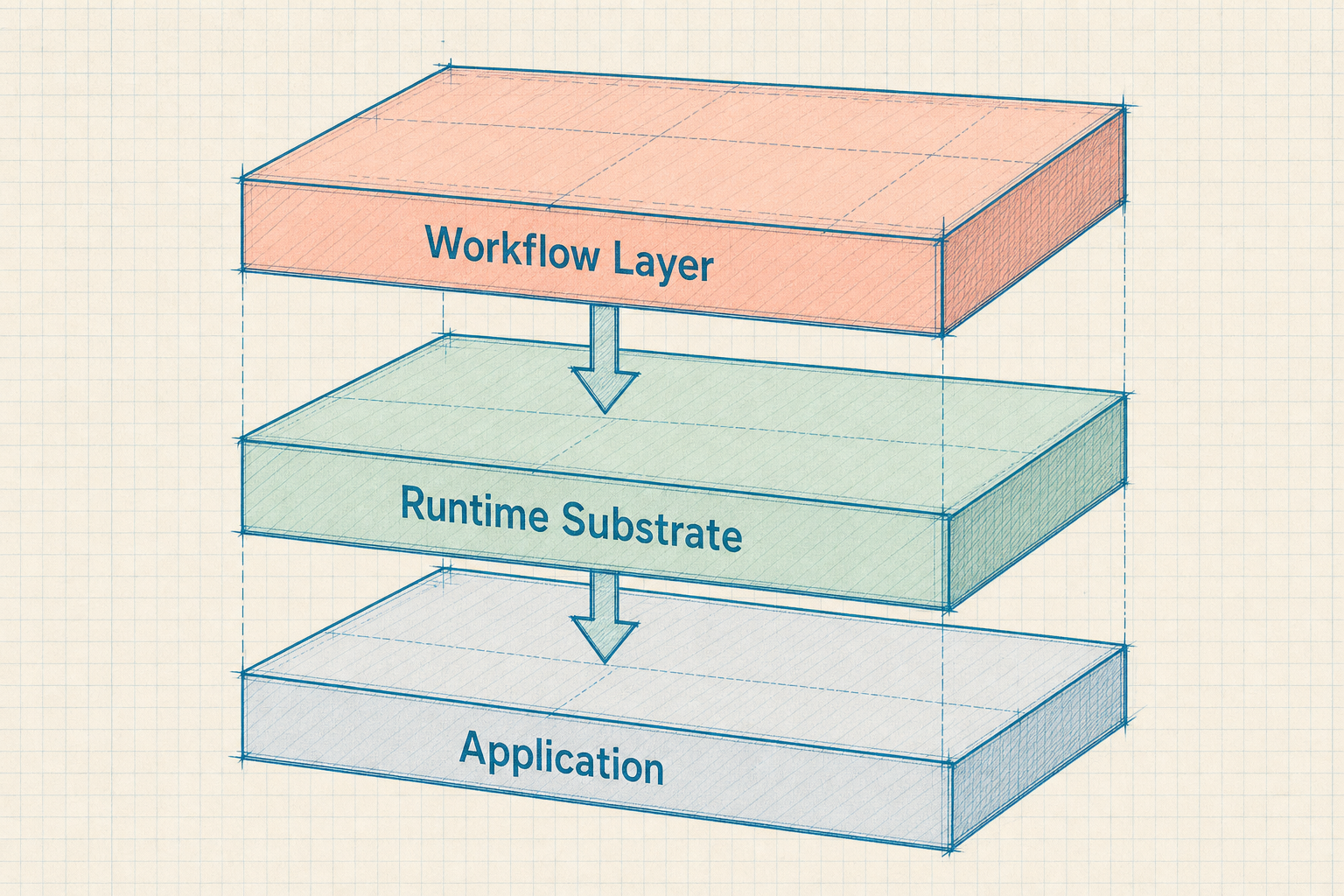
Section titled “Two abstraction layers in the ecosystem”Two related but distinct layers appear in modern AI-assisted engineering. They are complementary — not competing.
Workflow layer (AI-DLC)
Section titled “Workflow layer (AI-DLC)”Methodologies like AIDLC formalize AI-assisted software delivery workflows:
- lifecycle phases from intent to deployment
- multi-agent collaboration patterns
- evidence gates and quality criteria
- orchestration of planning, implementation, review, QA
Core question:
How do AI systems participate in software development workflows?Abstraction: process-centric.
Runtime substrate (AI Native SDLC)
Section titled “Runtime substrate (AI Native SDLC)”AI Native SDLC formalizes the infrastructure underneath those workflows:
- runtime harness and lifecycle management
- procedural DSL as operational source of truth
- deterministic materialization and gate enforcement
- contextual hydration and session continuity
- cognitive trace and procedural observability
- playbook-based expertise provisioning
- SDLC baseline versioning
Core question:
How do runtime architectures sustain long-horizon procedural cognitive execution?Abstraction: runtime-centric.
┌─────────────────────────────────────────────────────────┐│ Workflow Layer ││ Lifecycle methodology · stages · evidence gates ││ (AIDLC-style delivery workflows) │└──────────────────────────┬──────────────────────────────┘ │ runs on┌──────────────────────────▼──────────────────────────────┐│ Runtime Substrate (AI Native SDLC) ││ Harness · DSL · materialization · hooks · trace │└──────────────────────────┬──────────────────────────────┘ │ builds┌──────────────────────────▼──────────────────────────────┐│ Application ({workspace.target_root}/) ││ Any language · any structure · any framework │└─────────────────────────────────────────────────────────┘Workflow documentation tells you what stages exist. Runtime documentation tells you how execution survives between stages and sessions.
C4 system context
Section titled “C4 system context”flowchart TB
subgraph external["External"]
DEV["Engineer / Agent"]
PLANE["Plane"]
GH["GitHub / CI"]
OBS["Observability"]
end
subgraph system["AI Native SDLC"]
HARNESS["Runtime Harness"]
end
subgraph app_layer["Application"]
APP["target_root/"]
end
DEV --> HARNESS
HARNESS --> PLANE
HARNESS --> GH
HARNESS --> OBS
HARNESS --> APP
C4 container view
Section titled “C4 container view”flowchart TB
subgraph adapter["Runtime Adapter"]
HOOKS["Hooks"]
SKILLS["Skills & Commands"]
end
subgraph harness["Harness (.sdlc/)"]
DSL["sdlc.yaml"]
WF["Workflows"]
PB["Playbooks"]
GATES["Gates"]
TRACE["Trace"]
end
HOOKS --> TRACE
SKILLS --> PB
SKILLS --> WF
DSL --> GATES
WF --> GATES
GATES --> APP["Application"]
For the canonical workflow-vs-runtime comparison, see Workflow vs Runtime — this page focuses on harness decomposition.
Repository structure
Section titled “Repository structure”Three cooperating regions in every AI Native SDLC project:
┌─────────────────────────────────────────────────────────┐│ Runtime Adapter ({specialization_layer}/) ││ Reference implementation of harness binding ││ cursor | claude | openclaw | hermes-agent │└──────────────────────────┬──────────────────────────────┘ │┌──────────────────────────▼──────────────────────────────┐│ Harness (.sdlc/) ││ DSL · workflows · gates · bin/ · INDEX · trace │└──────────────────────────┬──────────────────────────────┘ │┌──────────────────────────▼──────────────────────────────┐│ Application ({workspace.target_root}/) ││ Your project — unchanged by install │└─────────────────────────────────────────────────────────┘workspace.target_root binds harness to application. It can point to ., packages/api/, backend/, or any path. The authoring repository uses app/ for dogfooding — not as a structural invariant.
Feature code never lives in .sdlc/ or the adapter directory. SDLC infrastructure survives project resets. Application code is ephemeral work isolated in git worktrees.
The procedural DSL
Section titled “The procedural DSL”.sdlc/sdlc.yaml is the operational source of truth. Not documentation — executable operational specification.
It defines:
| Section | Specifies |
|---|---|
workspace | Application root and stack profile |
runtime | Active adapter and hook bindings |
gates | Deterministic stage-transition contracts |
workflows | Command → YAML stage graph bindings |
integrations | Materialized plug-in manifests (empty until init) |
constraints | Worktrees, handoffs, ticket requirements |
qa | Evidence policy |
Everything the harness must sustain operationally is declared here. Runtime adapters, integration manifests, CI templates, and gate scripts are projections of the DSL — not independent sources of truth.
See Operational Layer and Workflows.
Materialization layer
Section titled “Materialization layer”Declarative DSL without deterministic enforcement produces operational drift.
The materialization layer interprets the DSL and builds verifiable runtime state:
| Mechanism | Role |
|---|---|
/sdlc:init | Discovers repository, binds workspace, generates integration manifests |
/sdlc:config | Adds, removes, or swaps integration plug-ins post-init |
/sdlc:doctor | Validates DSL ↔ code ↔ credentials ↔ directory indices alignment |
sdlc_gate_check.py | Blocks stage transitions without artifact proof |
sdlc_workspace_rebind.py | Retargets target_root across CI and integration bindings |
| Integration mutator | Generates {provider}.yaml manifests from catalog templates |
If the DSL declares a Jira integration, materialization verifies API credentials exist. If a gate declares feature_flow_complete, materialization checks manifest fields — not agent assertions.
Runtime state cannot depend only on probabilistic inference.
See Materialization.
Inference vs governed execution
Section titled “Inference vs governed execution”The architecture enforces an explicit separation:
Inference — what the LLM decides adaptively within a stage (implementation approach, error recovery, decomposition choices).
Governed execution — what the harness permits deterministically (stage transitions, gate passage, handoff recording, integration availability, worktree isolation).
Playbooks sit between the two: they formalize domain procedure (what, how, validate, measure, constraints, fallbacks) while leaving adaptive execution to the agent within those bounds.
This separation is what allows long workflows without the harness trusting every natural-language completion claim.
Long-horizon continuity mechanisms
Section titled “Long-horizon continuity mechanisms”Hooks transform the runtime into an interceptable operational structure. They observe, enrich, validate, and persist at every lifecycle point.
sessionStart: inject memory, handoffs, constraints, active run state, baseline procedural context. The runtime never starts empty.
stop: consolidate memory, generate handoff, prompt session closure artifacts.
See Runtime Layer.
Handoffs
Section titled “Handoffs”When a session ends, the harness generates a handoff containing operational state, architectural decisions, pending work, artifacts produced, gate status, and expected next steps.
Handoffs bridge sessions, agents, and environments. A stub handoff fails the mark-done gate — incomplete work, not a documentation gap.
Memory
Section titled “Memory”Memory is structured operational cognition — not chat history. Event-driven updates to architecture invariants, sprint state, business rules, and incident records.
SDLC baselines
Section titled “SDLC baselines”The harness version-controls its own evolution separately from application code:
| Baseline | Scope |
|---|---|
app_baseline_tag | Application restore point |
sdlc_baseline_tag | Harness + adapter infrastructure version |
Baselines enable procedural versioning, organizational sync, runtime reproducibility, and rollback of orchestration structures — not feature code.
Observability: two layers
Section titled “Observability: two layers”| Layer | Observes |
|---|---|
| Runtime trace | Tool calls, token usage, hook execution, agent lifecycle, file edits |
| Cognitive trace | SDLC stages, run manifests, decomposition, tickets, workflow transitions, artifacts |
Runtime trace answers: what did the agent do?
Cognitive trace answers: where is the engineering process?
Together they produce procedural observability — workflows that are auditable, navigable, and replayable.
See Observability.
Context as operational resource
Section titled “Context as operational resource”Context is finite. The harness treats token budget as an engineering constraint:
- scoped hydration at session start — not full repository load
- lazy playbook provision — domain expertise on demand
- bracket-notation INDEX — compact navigational structure
/sdlc:token-health— continuous audit and compression- handoffs as lossy compression of session state
Goal: preserve operational coherence, retrieval efficiency, and stability across long executions — not merely reduce API cost.
See Context Economics.
SDLC Learn — procedural capability acquisition
Section titled “SDLC Learn — procedural capability acquisition”New domain expertise enters the harness through /sdlc:learn:
research → critical synthesis → playbook materialization → delivery manifest → optional wire into workflows
Learned capabilities integrate procedurally — as .pb.yaml playbooks registered in the catalog — not as prompt dumps or chat context.
Examples from production use: pixel-perfect visual validation, DOCX generation, cognitive trace instrumentation, HTML deck scaffolding.
See Playbooks.
End-to-end execution
Section titled “End-to-end execution”The harness coordinates the full engineering cycle from a single high-level intent:
intent → discovery → decomposition → ticket hierarchy → architecture → wave execution (per-ticket feature-flow in isolated worktrees) → integration → deploy → post-deploy validation → reflect → handoffThe operator provides intent. The harness:
- decomposes and creates tickets
- provisions playbooks and capabilities
- executes implementation through isolated subagent contexts
- validates with deterministic gates
- produces evidence and trace artifacts
- closes operational cycles through materialized integrations
Macro orchestrator (/sdlc:e2e) composes workflows — it does not reimplement them.
See Lifecycle.
Integrations close cycles — they are not the product
Section titled “Integrations close cycles — they are not the product”Integrations connect the harness to external systems: ticket trackers, source control, CI, observability, deploy targets.
They close operational cycles — without them, the harness produces code locally but cannot complete the SDLC loop.
They are plug-ins materialized at init — manifests generated by commands and skills, not shipped pre-filled. Plane, Jira, Notion, GitHub Issues are interchangeable occupants of the work_items slot.
MCPs are user-configured runtime tools — separate from integration manifests. The harness declares requirements; the user supplies configuration.
See Integrations.
Reference implementation
Section titled “Reference implementation”AI Native SDLC is specification-first, runtime-agnostic, implementation-agnostic.
Runtime adapters (cursor, claude, openclaw, hermes-agent) are reference implementations of the harness binding contract. The procedural DSL, workflows, gate scripts, and materialization layer are constant.
Cursor (.cursor/) is the primary reference implementation today. Other adapters follow the same contract shape.
Structural indexing
Section titled “Structural indexing”Every navigable domain has an index entry point:
| Artifact | Index |
|---|---|
| Project navigation | .sdlc/INDEX.md |
| Workflow composition | .sdlc/workflows/README.md |
| Runtime scripts | .sdlc/bin/README.md |
| Adapter subsystems | {specialization_layer}/*/README.md |
| Playbook catalog | .sdlc/playbooks/PLAYBOOKS.md (lazy) |
Predictable entry points reduce retrieval entropy — the harness always knows where official state lives.
Worked vertical slice: /sdlc:e2e
Section titled “Worked vertical slice: /sdlc:e2e”The same chain is on the home splash and expanded with artifact counts in Show Me. This section keeps component-level names for architects.
One complete chain from trigger to observability — the docs-artistry elevation run:
| Step | Artifact / component |
|---|---|
| Trigger | /sdlc:e2e intent → sdlc_e2e_manifest.py init |
| Data | .sdlc/runs/docs-artistry-20260530/manifest.yaml, architecture-review-plan |
| Transform | Waves JAMBU-102..105 → worktree → gpt-image-2 assets → Starlight content |
| Output | app/public/images/docs/*.png, updated engineering pages |
| Observability | .sdlc/evidence/architecture-artistry-20260530/, trace events, e2e smoke |
Every stage transition is gated — agents do not self-certify completion.
What this is not
Section titled “What this is not”AI Native SDLC is not:
- a replacement for deterministic software infrastructure — it builds on top of it
- a fully probabilistic architecture — gates, doctor, and materialization are deterministic
- a single agent product — agents are coordinators within the harness
- a fixed integration stack — integrations are materialized plug-ins
- a framework for one language or stack —
target_rootaccepts any project
The result is operational infrastructure for governed, observable, evolvable procedural cognitive execution — not an “intelligent agent.”
Engineering shift being formalized
Section titled “Engineering shift being formalized”The transition is not:
chatbot → autonomous AIThe transition is:
workflow-centric AI systems →runtime-centric procedural cognitive systemsWorkflow methodologies define what stages exist. Runtime harnesses define how execution survives them.
That is the architectural layer AI Native SDLC formalizes.