
Why externalize expertise
Section titled “Why externalize expertise”An LLM agent session has a fixed context window. A monolithic agent that holds all operational and domain knowledge in its persona will context-collapse on long workflows.
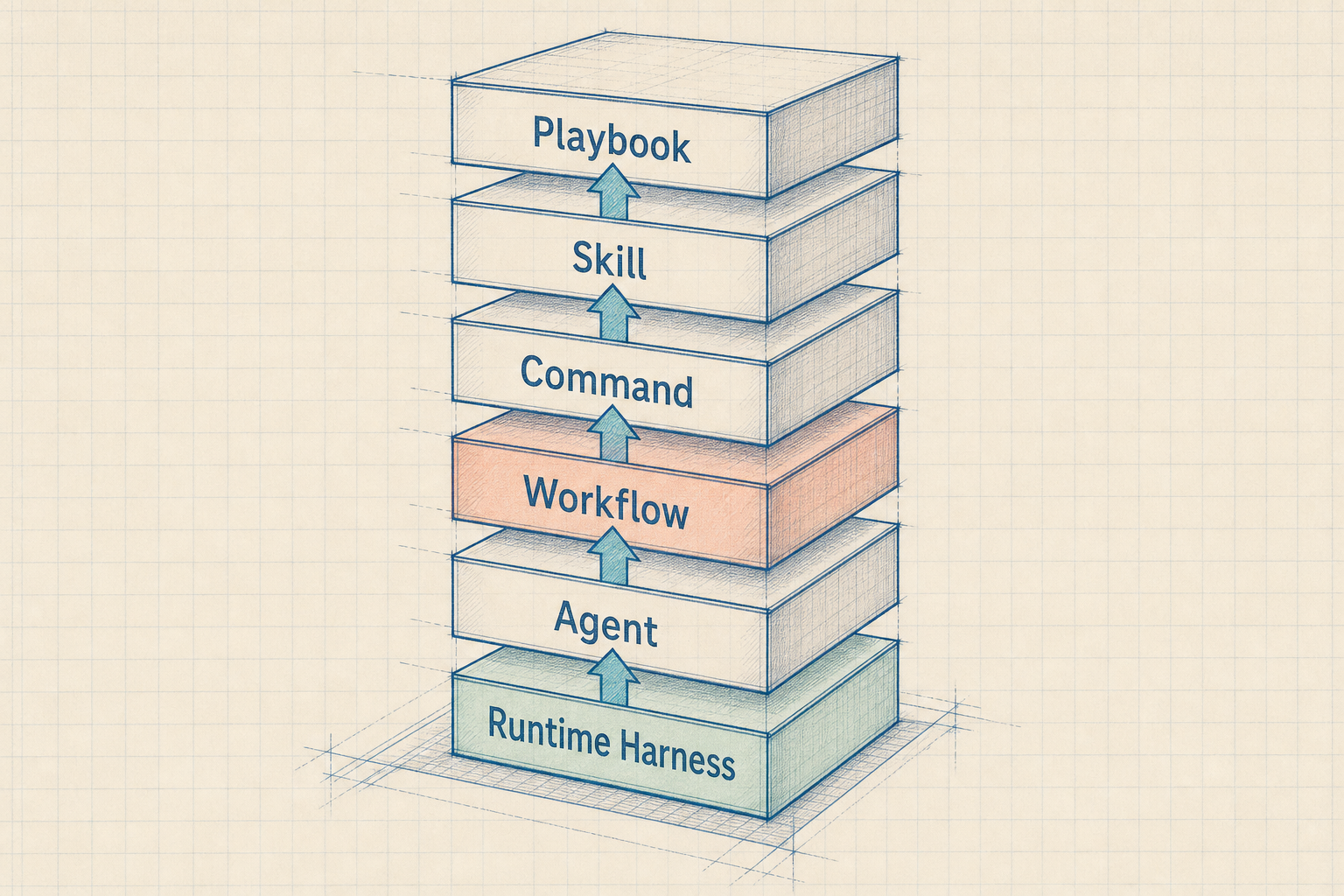
The composition stack externalizes expertise procedurally:
- load minimum harness contract at session start
- provision domain expertise on demand
- delegate vertical slices to isolated agent contexts
- enforce transitions deterministically outside agent control
Each layer has one responsibility. Higher layers orchestrate. Lower layers store or execute procedural knowledge.
The stack
Section titled “The stack”Playbook (.pb.yaml) atomic domain procedure ↑ composes intoSkill (SKILL.md) SDLC orchestration composition ↑ invoked byCommand orchestration entry point ↑ executesWorkflow stage (YAML) stage contract bound to DSL ↑ delegates toAgent (.md persona) isolated cognitive execution context ↑ coordinated byRuntime harness lifecycle, hooks, gates, memory, traceThe agent sits inside the harness — not at the top of the stack.
Playbooks — procedural operational specifications
Section titled “Playbooks — procedural operational specifications”Location: .sdlc/playbooks/domains/{domain}/{name}.pb.yaml
A playbook is not documentation, not a long prompt, not informal instructions. It is an executable procedural specification:
- what must be done
- how to do it
- how to measure and validate
- completion criteria
- constraints and fallbacks
Lazy-loaded via sdlc_playbook.py provision — never at sessionStart.
Acquisition: /sdlc:learn (research → synthesis → materialize → deliver).
See Playbooks.
Skills — procedural composition structures
Section titled “Skills — procedural composition structures”Location: {specialization_layer}/skills/{name}/SKILL.md
Skills organize SDLC operations. They may compose multiple playbooks for a task class:
| Skill | Composes |
|---|---|
worktree | Git isolation protocol |
spec-writer | Intent → structured spec |
{provider}-ticket | Work-items API (generated per integration) |
handoff | Session continuity recording |
qa-recording | Multi-resolution browser evidence |
browser-user | Authenticated browser via user MCP |
A skill is not required to be atomic. It coordinates capabilities and playbooks as needed.
Commands — orchestration entry points
Section titled “Commands — orchestration entry points”Location: {specialization_layer}/commands/{name}.md
Commands represent high-level intent. They do not execute procedures directly. They trigger:
- workflow stage graph from DSL binding
- skill invocations at stage boundaries
- playbook provision when
playbooks_when:matches - gate checks before stage transitions
The command is the operator interface. The harness executes the chain.
Workflows — DSL stage contracts
Section titled “Workflows — DSL stage contracts”Location: .sdlc/workflows/*.yaml
Machine-readable stage graphs: agents, inputs, outputs, blocking behavior, success criteria.
Workflows are runtime-neutral. They bind to commands via sdlc.yaml:
workflows: feature: definition: .sdlc/workflows/feature-flow.yaml trigger: /implement-featureSee Workflows.
Agents — isolated cognitive contexts
Section titled “Agents — isolated cognitive contexts”Location: {specialization_layer}/agents/{name}.md
One stage, one persona, one scope. Subagents dispatch in isolated worktrees/threads.
| Agent | Stage |
|---|---|
planner | Decomposition, interfaces, E2E scenarios |
implementer | Production code from plan |
reviewer | Architecture rule gate |
qa | Browser-native validation |
deployer | Staged release pipeline |
incident-resolver | Production triage → fix PR |
Separation prevents the same context from writing and certifying the same code.
Macro composition: /sdlc:e2e
Section titled “Macro composition: /sdlc:e2e”The orchestrator is a composer — manifest owner, wave orderer, gate enforcer. It composes feature-flow executions; it does not reimplement them.
| Stage | Delegates to |
|---|---|
| decomposition | planner |
| work-items-hierarchy | /spec:create per slice |
| execution | /implement-feature per ticket (subagent, worktree) |
| deploy | /deploy-release |
| reflect | /sdlc:reflect + /handoff |
Forbidden: implement {target_root}/** in main session; mark stages complete without gate passage; consolidate tickets into one worktree.
Inference inside governed bounds
Section titled “Inference inside governed bounds”| Layer | Nature |
|---|---|
| Playbook constraints | Deterministic bounds on procedure |
| Workflow success criteria | Deterministic completion definition |
| Gate scripts | Deterministic transition enforcement |
| Agent reasoning within stage | Adaptive inference |
The stack separates what must be true to proceed (deterministic) from how to accomplish the stage (adaptive).
Mental model
Section titled “Mental model”Think of the harness as an operating system:
- Playbooks = specialized drivers (loaded on demand)
- Skills = system calls (orchestration primitives)
- Commands = shell entry points
- Workflows = process definitions
- Agents = processes (isolated address spaces)
- Gates = kernel enforcement — no process marks itself done
- DSL = system configuration
The LLM is compute inside a process — not the OS.
Worked example: docs-artistry learn run
Section titled “Worked example: docs-artistry learn run”The /sdlc:learn pipeline that produced architecture doc review capability:
/sdlc:learn "architecture documentation artistry" → pb.engineering.pedagogical-profiles → pb.docs.architecture-review → pb.docs.visual-enrichment-gate → pb.docs.architecture-artistry (orchestrator) → /sdlc:e2e docs-artistry-20260530 → gpt-image-2 light-blueprint illustrations → Starlight content elevationThis is the meta-pattern: learn adds playbooks to the catalog; e2e implements vertical outcomes; gates verify assets on disk.
See Playbooks and Architecture.
See Architecture.