
From intent to deployed product
Section titled “From intent to deployed product”The lifecycle is a sequence of workflows composed by commands. At macro scale, /sdlc:e2e runs the full chain. At micro scale, /implement-feature runs one vertical slice.
Invariants: work-items ticket required, worktree isolation, deterministic gates, handoff on completion. The ticket system is whichever integration occupies the work_items slot — not a fixed vendor.
Phase 0: Install and init
Section titled “Phase 0: Install and init”npx @jambu/ai-native-sdlc@latest install/sdlc:initInit discovers the repository, binds workspace.target_root, detects profile, generates integration manifests, and sets status: operational. After init, the full lifecycle is available on this project.
See Distribution.
Phase 1: Context hydration
Section titled “Phase 1: Context hydration”Trigger: session start (runtime hook) or /hydrate-context
Reads: INDEX (scoped), LATEST handoff, sdlc.yaml, adapter memories, active run if any.
Output: agent resumes without full repository scan.
/sdlc:discovery produces strategic repo analysis before intent classification — distinct from E2E visual discovery stage.
Phase 2: Specification
Section titled “Phase 2: Specification”Trigger: /spec:create {ticket-id}
Workflow: spec-flow.yaml → spec-writer agent
Actions:
- Read ticket from active work-items integration
- Produce spec in
.sdlc/specs/ - Enrich ticket with technical notes (implementation plan)
- Register spec in INDEX
- Create git worktree
The spec’s Technical Notes section IS the implementation plan — vertical, self-contained.
Phase 3: Feature implementation
Section titled “Phase 3: Feature implementation”Trigger: /implement-feature (inside worktree)
Workflow: feature-flow.yaml
context-hydration → planning → implementation → review → qa → pr-creation → work-items-in-review → work-items-closurePlanning
Section titled “Planning”Planner produces affected files, interfaces, atomic tasks, E2E scenarios. Optional ADR draft if architectural decision required.
Implementation
Section titled “Implementation”Code following adapter rules and memories. Build and type checks must pass for the active profile.
Review
Section titled “Review”Reviewer validates against rules and ADRs. APPROVED | CHANGES_REQUESTED | BLOCKED.
Browser-native validation via user-configured MCP (typically Playwright). Evidence to .sdlc/evidence/{TICKET}/ in worktree. Worktree gate blocks QA in main workspace.
PR and ticket sync
Section titled “PR and ticket sync”PR opened with QA summary. Ticket moves to In Review immediately. On merge: Done, comment posted, evidence uploaded per integration API.
Phase 4: Deployment
Section titled “Phase 4: Deployment”Trigger: /deploy-release
Workflow: deployment-flow.yaml → deployer agent
Staged pipeline: build → version bump → staging → staging smoke → production → post-deploy validation.
Follow-up: /sdlc:post-deployment — version audit, smoke with video, observability error check, evidence manifest, rollback gate.
Deploy target comes from active deploy slot integration — generated at init, not bundled.
Phase 5: Observation and remediation
Section titled “Phase 5: Observation and remediation”Trigger: /fix-incident or CI incident workflow
Workflow: incident-flow.yaml → incident-resolver
Observability integration (if configured) provides error context. Agent reproduces, writes regression test, opens fix PR in hotfix worktree.
Macro path: /sdlc:e2e
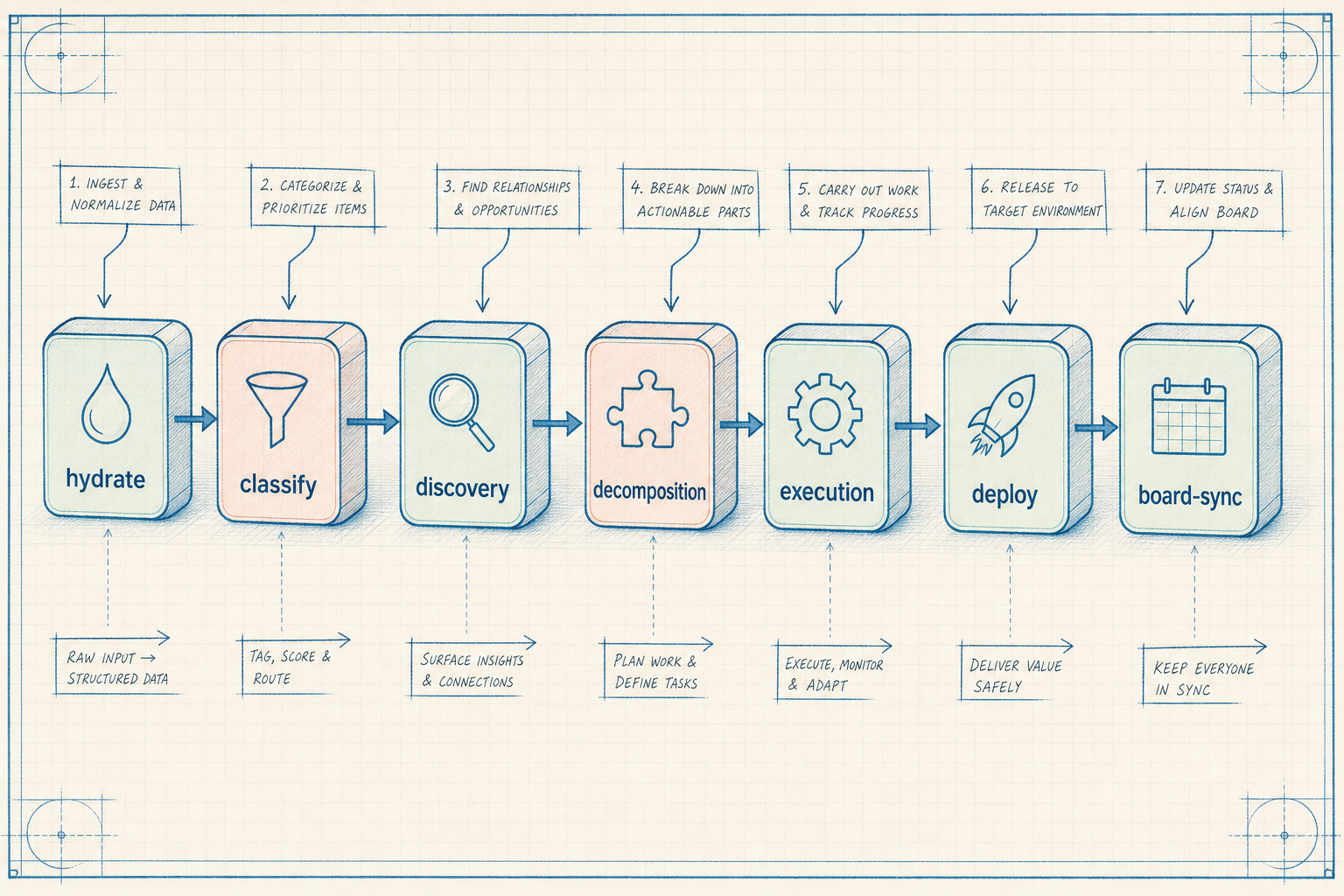
Section titled “Macro path: /sdlc:e2e”hydrate → classify → discovery → decomposition → work-items-hierarchy → architecture → workspace-rebind → wave-planning → execution (per ticket, parallel by wave) → integration → deploy → post-deploy → board-sync → reflect → handoffEach ticket in execution runs full feature-flow via subagent dispatch in its worktree. Orchestrator never implements {target_root}/** in main session.
Per-phase vertical trace
Section titled “Per-phase vertical trace”| Phase | Trigger | Data | Transform | Output | Observability |
|---|---|---|---|---|---|
| Intent | /sdlc:e2e | user intent string | manifest init | manifest.yaml | trace event |
| Hydrate | stage-start | INDEX, LATEST, sdlc.yaml | sessionStart hook | context packet | events.jsonl |
| Execution | wave ticket | spec, worktree | feature-flow subagent | PR, evidence | manifest ticket fields |
| Deploy | stage-complete deploy | CI, staging URL | deploy-release | production URL | post-deploy manifest |
| Close | mark-done | evidence dir | board-sync, reflect | Plane Done, handoff | QA manifest |
Closure requirements
Section titled “Closure requirements”| Requirement | Enforced by |
|---|---|
| Feature-flow success criteria | sdlc_gate_check.py |
| Evidence uploaded (if policy enabled) | work-items-closure stage |
| Non-stub handoff | mark-done gate |
| SDLC state committed | mark-done gate |
/sdlc:reflect pass | reflect stage gates |
| Doctor operational pass | /sdlc:doctor |
Lifecycle slot coverage
Section titled “Lifecycle slot coverage”Each phase binds to an integration slot at init. Examples:
| Phase | Slot | Example providers |
|---|---|---|
| Tickets | work_items | Plane, Jira, Linear, Notion |
| Source + CI | source_control, ci | GitHub, GitLab |
| QA | stack declaration | Playwright, Cypress |
| Observability | observability | PostHog, Sentry, Datadog |
| Deploy | deploy | Cloudflare Pages, Railway, Fly.io |
Same workflow YAML regardless of provider. See Integrations.
Cross-cutting: dependency gate
Section titled “Cross-cutting: dependency gate”When the active profile uses a package manifest (package.json, etc.), lockfile sync runs before commit. Enforcement: git hooks + adapter rule. Platform-conditional deps must be explicit for CI reproducibility.