
If you are new to AI Native SDLC, start with Show Me (what gets produced) and Introduction (when to adopt). This page is the install and layer map — read it before the full Architecture thesis.
Start here
Section titled “Start here”- Show Me — one intent through tickets, worktrees, evidence, deploy
- This page — install and three-layer map
- Architecture — internal PCRA decomposition (C4, harness names)
One sentence
Section titled “One sentence”AI Native SDLC is runtime infrastructure for long-horizon procedural cognitive execution in software engineering — not a chatbot, not a single agent, not a fixed tool stack.
The runtime harness (.sdlc/ + runtime adapter) coordinates governed execution. The LLM provides inference inside it.
Install
Section titled “Install”# Preferred — no global installnpx @jambu/ai-native-sdlc@latest install
# Global CLInpm install -g @jambu/ai-native-sdlcai-native-sdlc install --runtime cursor # or claude | openclaw | hermes-agentThen in your agent runtime:
/sdlc:initInit discovers your repository, binds workspace.target_root (any path, any language), materializes integration plug-ins, and sets the harness operational. See Materialization.
Three things to understand
Section titled “Three things to understand”1. The harness is the architecture — not the agent
Section titled “1. The harness is the architecture — not the agent”Agents coordinate: reason, decompose, select, provision capabilities. Operational expertise lives in skills, playbooks, workflows, gates, and memory — externalized from any single persona.
2. The DSL is operational source of truth
Section titled “2. The DSL is operational source of truth”.sdlc/sdlc.yaml specifies workspace, runtime, gates, workflows, constraints. Everything else — adapter rules, integration manifests, CI paths — is a projection materialized from it. See Operational Layer.
3. Workflow layer vs runtime substrate
Section titled “3. Workflow layer vs runtime substrate”Methodologies like AIDLC define delivery workflows (intent → deploy, evidence gates, lifecycle stages). AI Native SDLC defines the runtime substrate underneath (continuity, materialization, procedural observability, deterministic enforcement). They stack; they do not compete.
Workflow layer → what stages existRuntime substrate → how execution survives themApplication → what you build ({workspace.target_root}/)Repository layout
Section titled “Repository layout”{specialization_layer}/ ← runtime adapter (reference implementation).sdlc/ ← harness: DSL, workflows, gates, trace{target_root}/ ← your application (any stack)The authoring repo uses app/ for dogfooding. Your project uses whatever path init binds.
Composition at a glance
Section titled “Composition at a glance”/sdlc:goal (macro orchestrator — composes, never reimplements; `/sdlc:e2e` deprecated ADR-020) → /implement-feature (per ticket, isolated worktree, subagent) → feature-flow.yaml → planner → implementer → reviewer → qa → skills (worktree, handoff, ticket sync, qa-recording) → playbooks (lazy, on provision)One ticket → one worktree → one PR. Gates verify completion — agents do not self-certify.
Session continuity
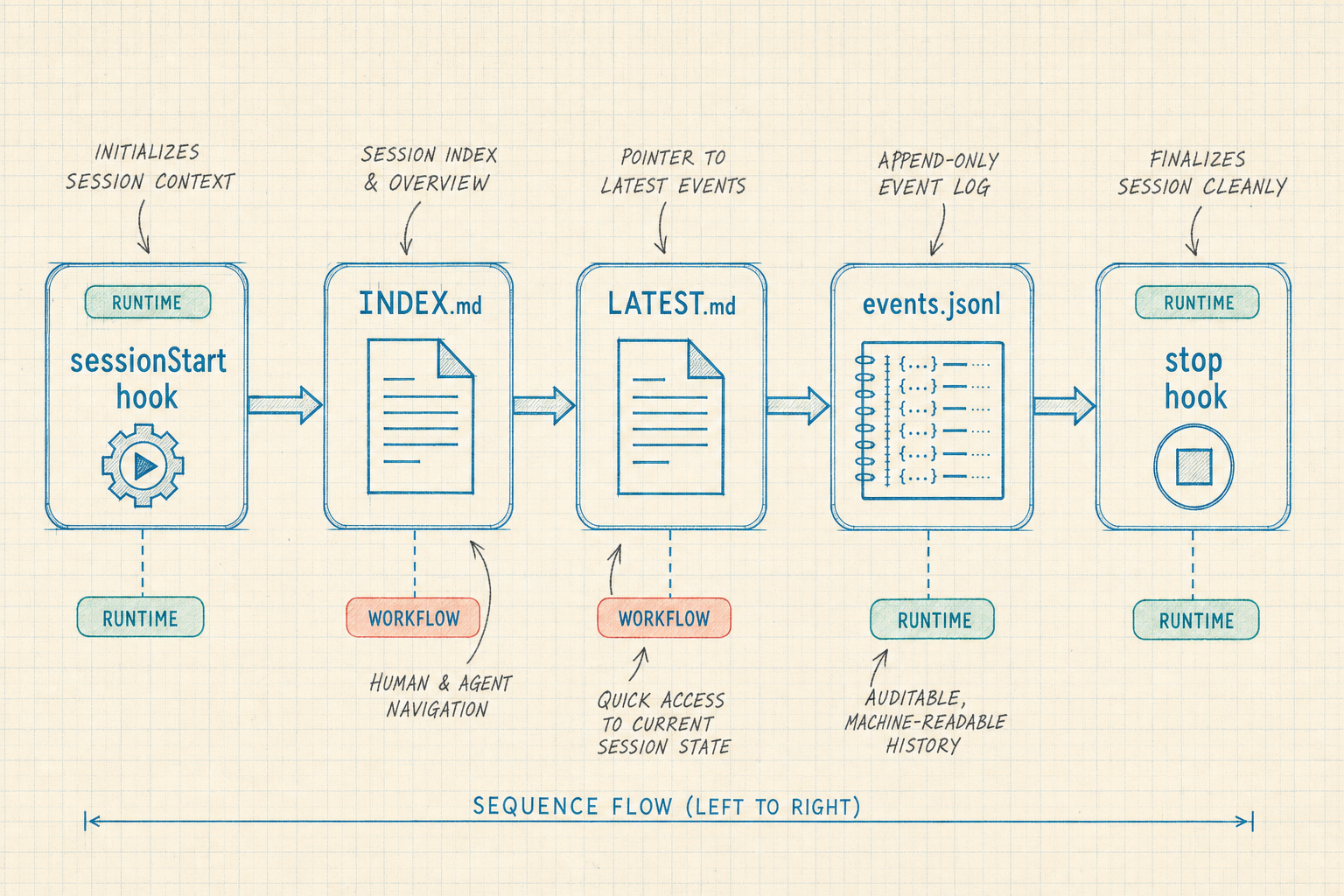
Section titled “Session continuity”sessionStart hook hydrates: handoff, memories, DSL status, active run.
stop hook enforces: memory consolidation + /handoff.
Stub handoff fails mark-done gate.
The harness never starts empty. Long-horizon execution requires this.
What closes the SDLC loop
Section titled “What closes the SDLC loop”Integrations are plug-ins materialized at init — not bundled product. They close cycles:
| Slot | Closes |
|---|---|
work_items | Ticket → spec → PR → Done |
source_control + ci | Branch → PR → merge gate |
observability | Production errors → incident flow |
deploy | Build → staging → production |
Plane, Jira, Notion, GitHub Issues are interchangeable work_items providers. Same workflows regardless.
MCPs are user-configured — the harness declares requirements; you supply setup.
Documentation map
Section titled “Documentation map”| Read | For |
|---|---|
| Architecture | Full runtime harness thesis |
| Materialization | Init, doctor, gates, manifest generation |
| Runtime Layer | Adapter contract, hooks, reference implementations |
| Workflows | DSL stage contracts |
| Composition Stack | Playbooks → skills → commands → agents |
| Integrations | Lifecycle slot plug-ins |
| Playbooks | Domain procedural specifications |
| Observability | Runtime trace + cognitive trace |
| Lifecycle | End-to-end execution path |
| Gates | Deterministic enforcement |
| Context Economics | Token budget as engineering constraint |
| Distribution | Install, init, baselines |